The Frosts move to Leddington
Jackie Tweedale
On April 3rd 1914 Robert Frost and his family moved to Little Iddens, Leddington arriving when the blossom and daffodils were in bloom. They found a little 2 storey cottage, which was a bit of a squeeze for 6 people but, the situation was stunning with views of May Hill over a ‘green and golden land’.1 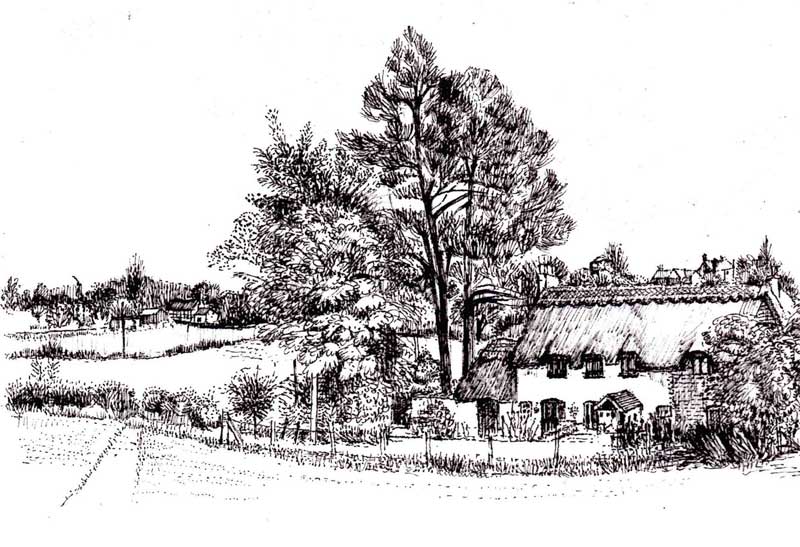 The house had a vegetable garden and orchards of apple, plum and pear trees. They arrived in 2 carriages having done a tour of the area to Gibson’s home and The Gallows at Ryton.
Frost already knew Wilfrid Gibson and Lascelles Abercrombie, having met them in 1913 in London at the Poetry Bookshop. Frost had met Edward Thomas in October 1913 and their meeting was to become one of the great literary friendships. Abercormbie and Gibson had persuaded Frost to join them in Dymock and live in the real countryside. He had been living in a bungalow in Beaconsfield having moved from America to seek success in England as a poet. Formerly, a farmer and a teacher a few of his poems had been published. In England a book of poems was published ‘A Boy’s Will’ (1913) and his reputation was beginning to grow.
On April 25th 1914 Edward Thomas and his children, Merfyn and Bronwen, came to stay at Oldfields, near to the Frost’s for a week. Thomas met Abercrombie for the first time. Thomas knew or had heard of all the Dymock Poets before this visit. He had reviewed Gibson and Abercrombie’s poetry. Rupert Brooke had visited him at his home in Steep, Hampshire and Thomas had stayed with him in Grantchester. Frost and Thomas went for long walks and discussions in the fields, orchards and lanes. This was the start of Thomas becoming a poet encouraged by his friends. In April 1914 ‘In Pursuit of Spring’ was published and Frost declared that he had already written poetry.
Gibson and Abercrombie were well known poets at this time. The latter had been a clerk in a quantity surveyor’s office and was a freelance journalist. Gibson had moved from Northumberland to London and worked as an assistant editor for a poetry magazine. Gibson was well known in America and wrote poetry based on everyday events and tried to reflect the speech of ordinary people. D.H Lawrence described him as ‘one of the clearest and most lovable personalities I know’.2 The Abercrombie’s also were welcoming hosts with many visitors even though the washing facilities were primitive – a shed out of doors, with a curtain instead of a door.
The poets were poor and life was hard but their poetry flourished. Catherine Abercrombie describes life at Ryton ” I had a permanent gipsy –tent under the ‘seven sisters’ as our elms were called, and sometimes I would have an iron pot over a fire with a duck and green peas stewing in it, and Lascelles, John Drinkwater and Wilfrid Gibson, would sit round and read their latest poems to each other , as I lay on a stoop of hay and watched the stars wander through the elms, and thought I had really found the why and wherefore of life”.3
In 1916 Gibson wrote a poem called ‘Trees’ recalling a similar scene:
‘The flames half lit the cavernous mystery
Of the over-arching elm that loomed profound
And mountainous above us, from the ground
Soaring to midnight stars majestically,
As, under the shelter of that ageless tree
In rapt dreaming circle we lay around
The crackling faggots, listening to the sound
Of old words moving in new harmony.’4
1Lawrance Thompson. Robert Frost, The Early Years. Johnathan Cape. 1967
2Linda Hart. Once They Lived In Gloucestershire. Green Branch Press. 2000
3Keith Clark. The Muse Colony. Redcliffe Press. 1992
4Collected Poems of Wilfrid Gibson. 1905-1925. MacMillan & Co. 1926.
Image: Little Iddens and Oldfields © and courtesy of Barbara Davis


